


When new newspaper advisor Evan Solís walked into room 134’s forgotten and neglected back storage room, he had an idea that teachers before him hadn’t thought of in years. Over the next few months, Solís slowly transitioned the room into a fully functioning darkroom, picking up some supplies from other teachers and grabbing others from thrift and camera stores.
By December, the room was fully stocked with bottles of developer, fixer and stop bath, along with four enlargers, two timers, and all the materials needed for creating prints. Solís had gathered all the supplies, but the next steps were in the hands of the students.
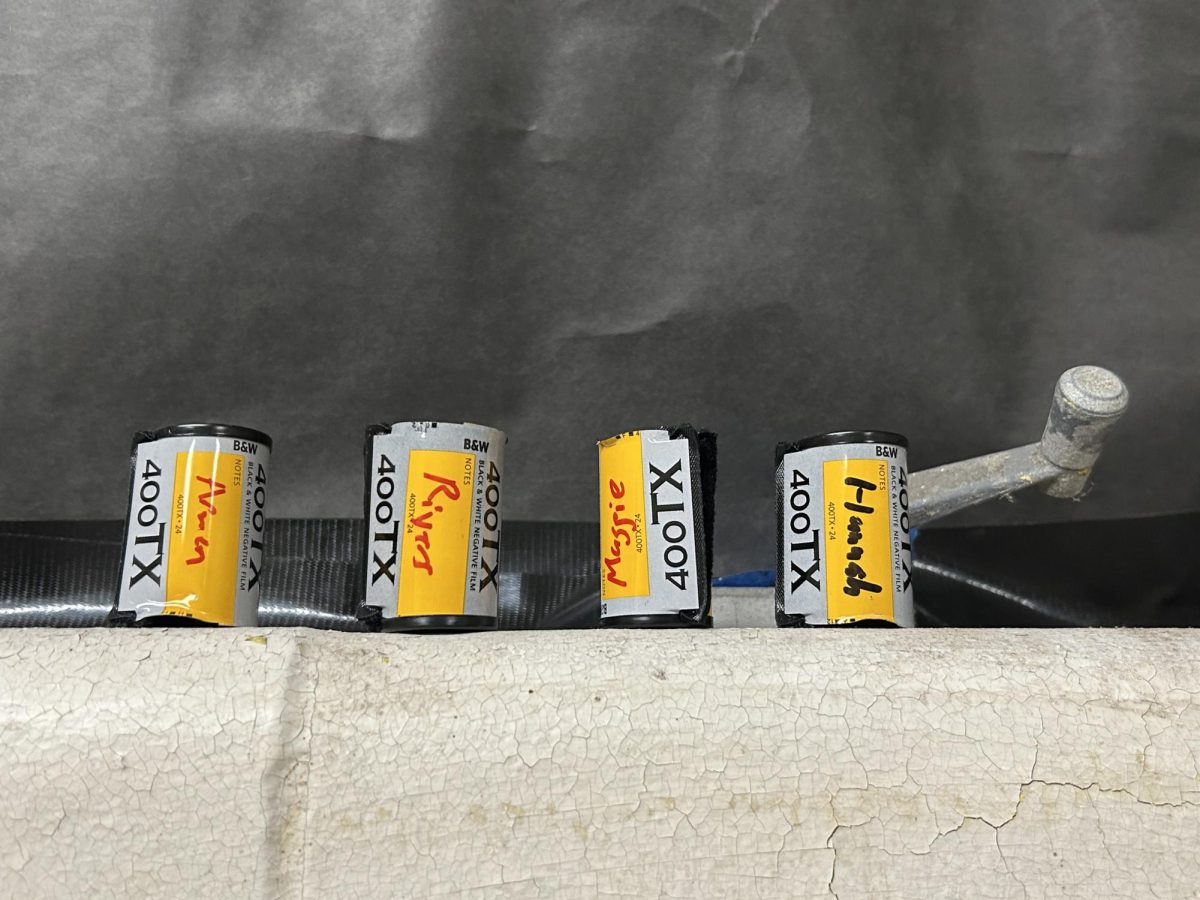
Solís began demonstrating the darkroom to all of his students, including newspaper classes and photojournalism classes, hoping to pique their interest. He began providing them with film cameras, along with rolls of 35mm film at 400 ISO, each of which contained 24 shots. After they shot the film, Solís taught them how to develop the negatives themselves and then how to begin printing their photographs. Sophomore photojournalism student Alina Curtin had never had an interest in film cameras before Solís’ introduction, but doesn’t see herself looking back anytime soon.
“My interest in it began with the demonstration he gave to my photojournalism class,” Curtin said. “One of the things I loved about learning to print was that it was a physical way to show my pictures, and there’s so much care that goes into it. Secondly, I think it’s just really cool. If you tell somebody, ‘I made this picture out of using particles of silver,’ who wouldn’t be interested?”
Currently, students can develop black and white film, which goes through a meticulous process to get printed. First, the negative has to be aligned in an enlarger, where a lens and a light project the image onto an easel. From there, the image must be focused. By isolating the room in red light and by adjusting three settings – aperture, filter and the time you expose the image to photosensitive paper – you can produce a print.
According to Curtin, the manual process of creating photos in the darkroom is important during a time when AI-generated images thrive online.
“Artificial intelligence has become a huge threat to art forms such as photography and music,” she said. “Using just the topic of the dark room, AI may be able to generate some generic picture of a tree, but it’s important for people to know how a human can develop a picture of a tree and how much more skill it takes, and it therefore adds more value. The AI didn’t have to use twenty different test strips, play with aperture and figure out what filter to use.”
For Solís, the closet showed its true colors to him as he dug deeper, and he realized its possible past usage.
“It was pretty clear that it had been a darkroom at some point because the windows were all halfway closed off and there were a bunch of old film cameras and usable darkroom equipment,” Solís said. “I believed that it could be so again.”
Similarly to Curtin, Solís sees the value in reviving an old art form in a modern era of thriving digital photography, which his students are much more familiar with.
“I think it’s just very different from what we’re used to in terms of photography, students grew up with digital negatives, smartphone negatives, and literally have a machine that’ll take high quality photos in your pocket at all times,” he said. “This analog practice is good for y’all in a bunch of different ways. It teaches you skills that are useful in and outside of photography, it teaches you patience, it teaches you to think ahead.”
The process itself, despite being tedious at times, is very manual and allows the results to be all the more fulfilling after finding the sweet spot with your print.
“It’s a very hands-on process,” Solís said. “The typical kid does not create that much, and this is a process where from negative to print you have fully created the image. I think it gives you a lot of agency and I can see when kids are happy and proud of the work they’ve done, and that makes me happy as well.”
For another photojournalism student, sophomore Elicia De Leon, seeing Solís’ darkroom demo inspired her to pick it up as well, especially since being provided the resources at her own school.
“My dad and my grandpa did film journalism in high school, and I learned about it through friends I have in the newspaper.” De Leon said. “I really want to work with film more, and higher tech that I want to use in the future that are out of my price range so I’m thankful that I’m able to use those things here.”
The solutions within the printing process, such as developing liquid and fixer, must be balanced correctly to produce the print, which has been a highlight for De Leon.
“This art form has been alive for decades or centuries,” she said. “You can touch things, and you can actually learn how things are happening in real time. You get to work with chemicals, like a real chemist.
So far, the darkroom has inspired a handful of students to discover an art form that thrived years before them. It’ll continue to be available to all students, and with Solís’ direction, will pave the way for a new generation of artists, photographers, and even chemists.