

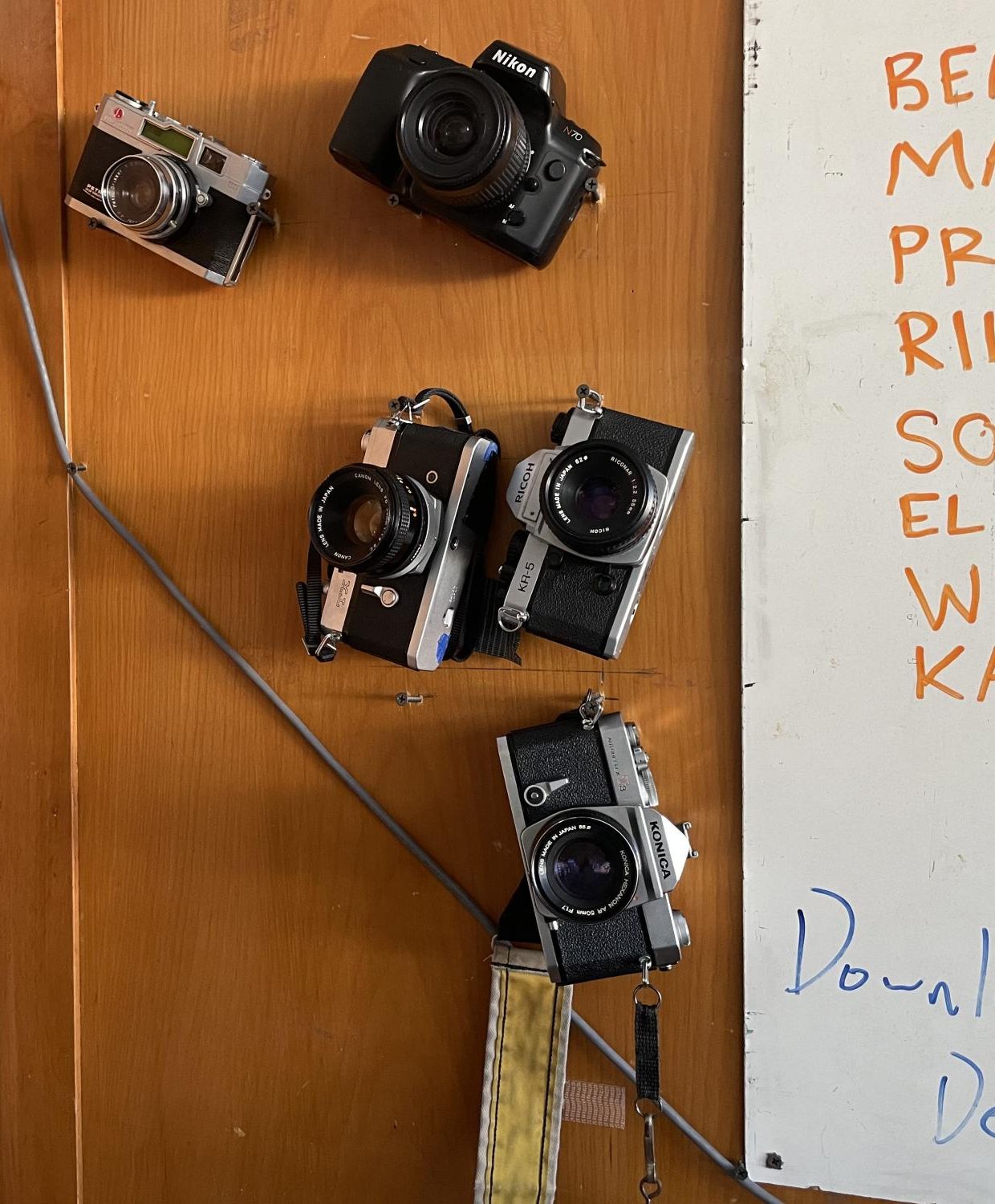
When your friends or family show you old pictures of themselves, they surely pull out dusty photobooks from forgotten drawers. But as 20 and 30-year-olds start having kids, most of their baby photos end up on Snapchat stories or Instagram posts. This is due to the fall of film cameras– thousand-dollar machines that require special paper, skills, and surroundings– and the rise of digital cameras. These handheld devices give instant results, clear instructions and endless opportunities to get the perfect shot. It’s no surprise that after the release of the first fully digital camera, the Nikon D1, in 1999, film camera sales dropped to only 2% of what they were in 2003.
The daguerreotype, invented by Louis Daguerre in 1839, used silver-plated copper slides to capture the light exposed by his surroundings. Although this process was much quicker than Joseph Nicephore Niepce’s earlier method of heliography, it still required the necessary camera and skills to produce a good photo. Photography was first made commercially available after the development of the mirror camera in 1840 by Alexander Simon Walcott. Using Henry Fox Talbot’s film, he’d create a positive image on paper soaked in table salt and silver nitrate. With the success of this process, Walcott and his partner Johnson opened portrait studios in New York City, Washington DC and England. This began the desire for quicker, higher-quality photos.

But because analog cameras have existed since the 1800s, they have many problems. Some photos didn’t last, others took too long to develop, but all of them were the only copy that would ever exist. Back then, it was worth it. That might have been your only chance to preserve your likeness. As our lives become busier and faster-paced, we have less time to sit for a 30-minute portrait or set up a dark room to develop photos. This explains the rise of digital cameras and disappearance of traditional photography– why wouldn’t you want a device where, with the click of a button, you can immortalize anything in your sight? The ease and accessibility of digital photography caused the film market to diminish. Despite the hassle, newspaper adviser Evan Solís believes that shooting film is an important art to keep alive. He’s worked with film cameras for more than ten years.
“When I was in high school, I ran a film club and did movies with my pals,” Solís said. I wanted to go to UT for RTF– radio television film. And so that got me into media in general, but it wasn’t until my mid 20s that I started doing photography.”
One of Solís’ earlier jobs had film cameras that they lent out for free. After borrowing one, he discovered that he really liked the process. His experience was similar to many other film photographers’ in the way that they do not start out with all the tools or skills necessary. Solís recognized his privilege to have everything set up for him.
“It was very rare to see someone in high school doing film photography back then. It’s still expensive, and it’s not accessible to everybody. Those who are privileged enough to be able to use it have gotten more into it,” he said. “But at the same time, if I had an iPhone, I could take as high-quality of a photo on my iPhone as I could on basically any of the cameras that we have.”
Film cameras, although complicated, prove worth it. Manny Almeida, the president of Fujifilm’s North American imaging division, describes how a large portion of today’s film photographers are wedding and portrait artists in their 20s and 30s. He believes that by their use of film, they’re able to “charge for a premium product because film has a different look and feel than digital.” Film photographers are able to create one-of-a-kind, tangible artworks that show more effort and dedication than those of iPhone photographers. For consumers, it shows that time and effort were put into the photo.
According to junior Wyatt Norman, analog photography is “precious.” Compared to digital photography, he believes that film is much more desirable as time goes on. “Right now in Hollywood, some of the major blockbuster productions are spending thousands of extra dollars to laser-on each frame of a digital movie onto film strips, which are then re-scanned into a video file to try and capture the signature film look,” Norman explained. “When people talk about that, they mean a certain warmth, punchy contrast, noise and grain structure that is instantly recognizable, but very hard to replicate.”
Solís believes that the process is what makes film photography so desirable. “I think shooting analog is very different from how kids are now used to working in the world,” he said. “It’s not instant gratification, it’s a very contemplative process.” Solís understands firsthand that different people have different processes, another thing that makes analog photography so unique and personal.
“People will try to replicate the ‘film look’, but can never mirror the way you interact with your work and shape your tastes with an analog medium,” Norman added. He agrees that shooting with film cameras is a difficult process, but a worthy one. Both prefer the originality of film over the ease of digital photography.
As digital photography gets more accessible and advanced, analog photography only becomes less practiced. Solís claims that “mostly everybody has a cell phone, which means most everybody can be a photographer, which is a good thing. It democratizes it.” On the same page, Norman first became interested in photography during the COVID-19 pandemic, using his phone to document his house and yard. Once he started using film cameras a few years later, his subjects changed drastically.
“When each picture is costing you money, you are very selective and meticulous when shooting,” Norman said. “That brings out intention and quality in your work that cannot be replicated on a digital format.” He says that digital photography allows the person behind the camera to make endless adjustments, whereas film photographers have no feedback until they “develop film and receive the negatives, usually a week or so later.”
This complication makes the process harder, but Solís believes it makes him a better photographer. Norman claims that “every single picture you take will be a massive stride in your artistic growth.” These perspectives allow more insight into why the film market is making a comeback. Because digital photography is so widespread, film photography becomes rare and sought after. This proves that as the digital revolution increases, the desire for analog photography only increases.