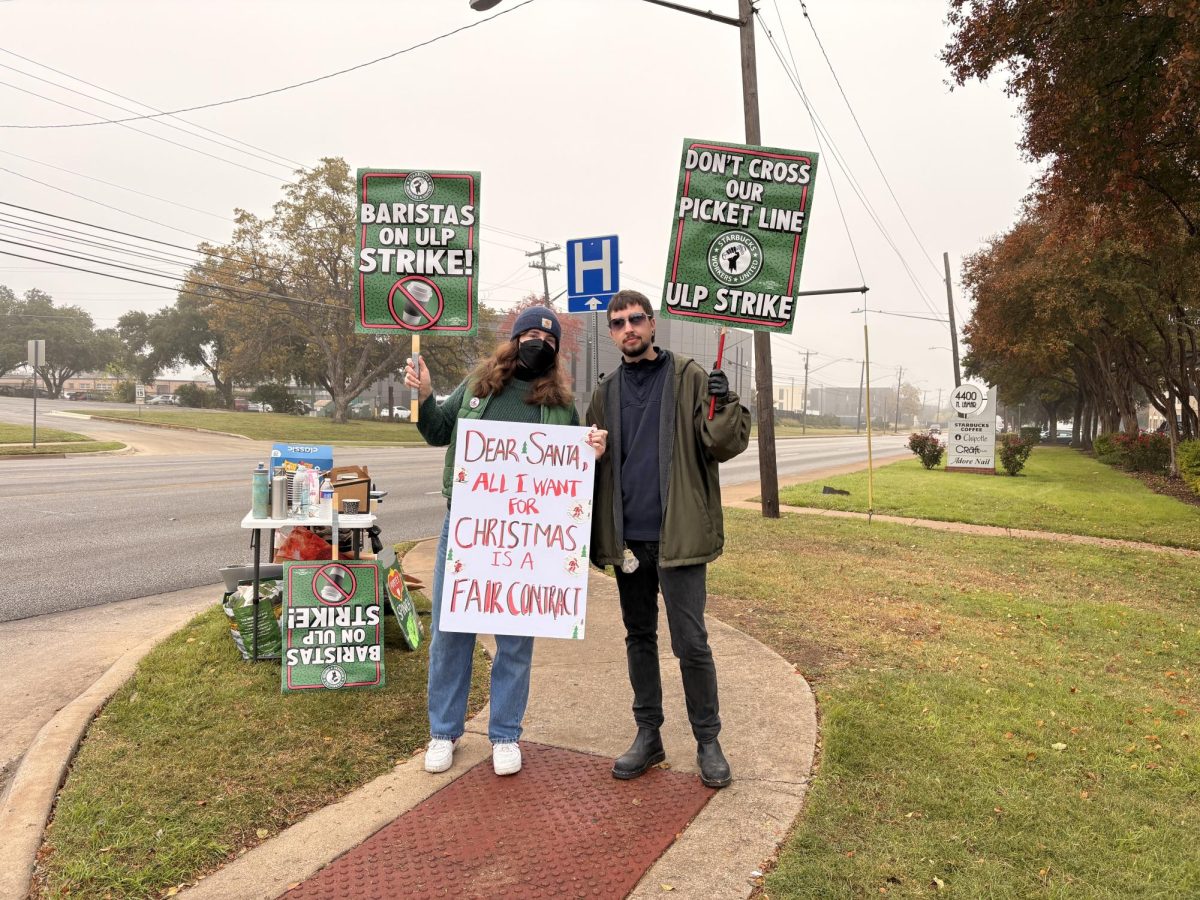
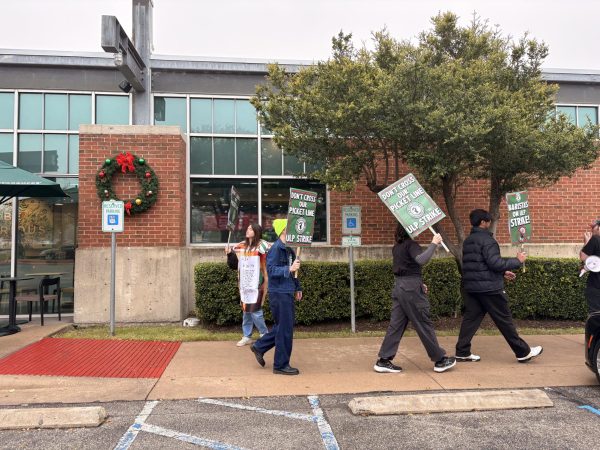
This morning, on Dec. 12, cars honked in support of Starbucks union workers protesting at the North Lamar and 45th St. location for higher wages, better benefits and a flushed out contract with the company. Over one thousand union workers have been on an unfair labor practice (ULP) strike nationwide since Thursday, Nov. 13 when Starbucks refused to finalize their proposed union contract over six months ago. This strike, known as the Red Cup Rebellion, reached Austin yesterday with the first day of protests at the North Lamar location.
As customers entered the store, they were faced with workers marching in a circle outside chanting phrases like “we’re out here fighting for our contracts” and “get on the mic, we’re ready to strike.” Patrons were individually stopped and told not to pass the picket line. Protesters also stopped walkers and drivers alike to hand out papers that were headlined with the phrase “no contract? No coffee!” Text underneath read, “union baristas are on ULP strike to win a fair contract and protest Starbucks’ historic union busting.” At the bottom of the handout was a QR code that sent scanners to a pledge to support workers on strike.

(Arwen Pelletier)
One of the workers on strike, Ayden Lee, a McCallum graduate, expressed his frustration with the company, their practices and unwillingness to accommodate the union’s wants.
“We are striking mainly for livable wages,” Lee said. “That’s the main thing because the company was having ongoing negotiations with the union, but then wanted to halt negotiations once the topic of wages and related things came up. The proposed numbers for wage increases that the union has given them would only equate to them losing about 1% of their daily profits.”
If the union’s proposed plan were to pass, wage increases for workers would change based on the livable income index for the city or county they reside in. For Starbucks employees in the Austin area, the wage they receive isn’t equal to the projected livable wage needed to be received to live in Travis County, and it can lead to disadvantages for employees.
“I get paid $16.25 an hour, and I have some other partners and baristas who have to pay much higher rent than I do,” Lee said. “The adjustment to livable wage usually would be about a $4 increase. Our current wage just isn’t sustainable.”
Despite the uproar from unionized workers and supporters, Starbucks continues to stay staunch in their position. The company has made it publicly known that they believe that their employees have one of the best jobs in the industry and average $30 an hour in pay and benefits. Overall support of the strike has been highly publicized, but according to Starbucks, the union only represents 4% of partners. Starbucks has also announced that they’re implementing a Green Apron Service that increases partner hours, promotes career growth and allows employees to more easily change their schedules.
Junior Opal Rodgers went to the N. Lamar location this morning and when she went inside to pick up her online order, she was faced with the protesters. Rodgers said she can see both sides of the aisle on the issue of the strike.
“I think there are definitely two different sides of the story that you could look at,” Rodgers said. “The first one is that when you interview for a job like that, you know you’re signing up to work for Starbucks. They give you what you’re gonna be paid and your workload upfront. The second one is that I understand that they get a lot of customers all the time and they’re always hammered, so their frustration is understandable.”
Despite the two separate sides of the strike, the implementation of the Green Apron Service and other forms of outreach hasn’t changed many union workers’ beliefs. For Lee, the difference between high ranking executives and everyday partners is extremely vast and needs to change.
“It’s just really unfair, and we want to let the company know that we would like a living wage while their CEO was paid $96 million in his first four months as CEO,” Lee said. “We have some partners and baristas who can’t even afford medicine or health care, and they have to rely on the company’s health care.”
The unionized workers aren’t alone in their fight. Texas State Representative Lauren Ashley Simmons and Harris County Commissioner Rodney Ellis have voiced their support for the strike on social media. Over 100 Congress members have made their support public for the partners on strike, and support has also come from Senator Bernie Sanders and New York City mayor-elect Zohran Mamdani.
From support to fighting back in creative ways, Lee believes that unionized workers and allies need to focus on finding creative solutions to finalizing a contract plan and prevent company mix-ups.
“I think that we need to be as creative as possible,” Lee said. “At the end of the day, see what hoops you can jump through with the company, because there’s lots of legality that you can get caught up in. Any creative way is an amazing way.”