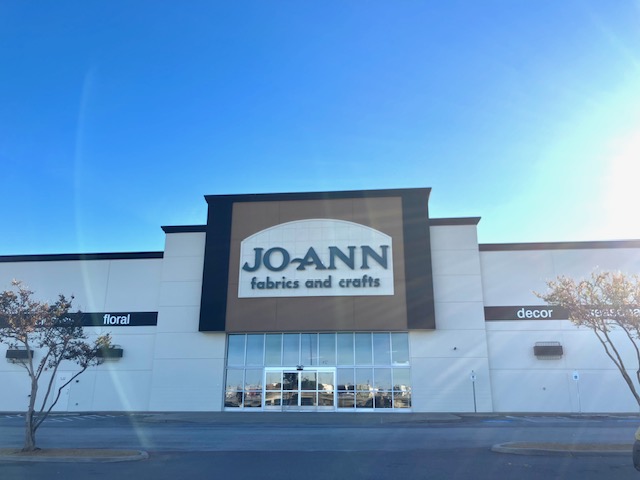
The big box craft supply store Jo-Ann’s officially closed all 800 of its stores on May 31. this year. The company declared bankruptcy for the second time in January and was forced to close completely.
This was more than a little loss for the crafting community. Jo-Ann’s held the largest selection of fabrics, sewing patterns, art supplies, and other bits and bobbles that were available to people, especially in Austin. The closing of the stores has left people in a lurch on finding other alternatives for supplies, with no other in-person store having quite the same amount of options and attention to customer service, and online shopping for fabric being a nightmare.
I remember when I was little, a family friend, Milt Clark, who is an avid seamstress and crafter, took me to Jo-Ann’s so he could teach me how to sew. He used to make me dresses and costumes and proudly show off how he found the different pieces from Jo-Ann’s. Since then, I developed a sweet spot for the store and sewing, and when I decided to try it out on my own, I spent hours in the store poring over the aisles and selecting the perfect fabric for my project.
Now that the store is closed, Clark has been looking for alternatives and finding nothing that fills the hole Jo-Ann’s left. Especially in convenience, he used to be able to run down the street any time he needed something, but now he finds himself driving miles for some simple material.
“What I miss most is the convenience,” Clark said. “Being able to go down there quickly and get whatever I needed is something I didn’t even realize was such a privilege. It’s just a hassle to find the time to drive somewhere with the supplies I need now.”
It’s a common grievance in the community. In online forums and Facebook sewing clubs, people are mourning the loss of what feels like the death of their hobby. Many people are faced with having to struggle to find the right supplies. When at Jo-Ann’s, the friendly customer service workers could help you find the right products even if you were an absolute novice. McCallum fashion show designer and art major Bea Billig shared similar sentiments.
“With the recent closings, I think it will limit the creativity artists are able to have with their work,” Billig said. “Jo-Ann’s has always been very good at carrying specialty items, appealing to various niche markets within the sewing community. There’s no other real alternative store in Austin because most stores simply don’t carry the specialty supplies needed for artists to reach their max potential.”
As a fashion show designer, Billig, like many other designers, is seeking new ways to source her fabrics and supplies for the upcoming project.
“It’s definitely going to be more of a struggle this year, as it will take much more planning ahead to find the right fabric for the job,” Billig said.
Sondra Primeaux, the sponsor for the Mac Fashion Show for the past two years, has been pushing her students to explore Austin Creative Reuse.
Austin Creative Reuse is a local non-profit and the biggest reuse craft store in Texas. The store works by taking in donations of people’s unwanted crafts and then resells them back to the community at a very low price.
As Jo-Ann’s closed, the store noticed increases in customer traffic, especially in sales of fabric, as observed by Creative Reuse’s communication coordinator, Seespriya Jakowlew-Dahlhaus.
“We have seen an increase in our fabric sales,” Jakowlew-Dahlhaus said. “Fabric has always been a best seller for us; it makes up about 25% of our donations and sales, and we’ve definitely been selling more of it.”
Primaeux remembers that around 10 years ago, there were a few small fabric stores, but unfortunately, they have all died out since then. She hopes that the sewing community will have a revival, and there will be more alternatives to go to now that the market has opened up.
“My hope is that smaller businesses start to pop up and take the place of Jo-Ann’s,” Primaeux said, “Like how a good thing happened when more people abandoned buying books on Amazon, more small bookstores started popping up around Austin. So I hope something like that happens with this.”
However, as Jakowlew-Dahlhaus brought up, small businesses usually can’t match the price points of larger stores, so crafters on a budget might find more solace in places like Hobby Lobby and Michaels. However, many feel that these stores just don’t provide the same sort of service Jo-Ann’s did.
“Some people don’t go to Hobby Lobby because they don’t agree with their politics,” Jakowlew-Dahlhaus said. “Michael’s is a good craft store, but it doesn’t have a very big sewing department, so Jo-Ann’s was always the most appealing option.”
Not to mention the service level that Jo-Ann’s provided. True, Amazon is always an option, but it doesn’t give people that face-to-face experience that was so quintessential to Jo-Ann’s. There would be workers there to walk you through what supplies you needed, the differences in fabrics, and guide you along your creative journey to make it as smooth as possible. For many people like Clark, this was a big part of the appeal.
“I knew all of the people who worked there because I was in and out all the time,” Clark said. “And I’m really gonna miss a lot of those folks.”
Different factors like these are what push people away from buying online, especially for fabric. It’s a market that is really difficult to transfer to online shopping because of how tactile the medium is.
“Shopping for fabric online is difficult because I like to feel the fabric, and you can’t translate that online,” Primaeux said.
Fortunately, being the creative types, crafters are finding new and inventive ways to source materials.
“I’ve been going to Goodwill and buying curtains to use as tablecloths,” Clark said. “And spending all my time there on the hunt for other fabrics I can use.”
For Primeaux, she’s found materials in the community around her on Facebook groups, or just making use of old wedding gowns and silk scarves.
“There’s honestly so much fabric in the world, and there are so many creative ways to get it, so I really hope that people explore that more,” Primeaux said.
In any case, it seems that although there is a definite loss in the crafting community, in some ways, it’s a blessing in disguise. Allowing creatives to think outside the box and explore more with how they can make things work without everything served up to them on isles and isles of shiny plastic. It may be a time for the community to come together and support each other in their passions. It may be time to get crafty.