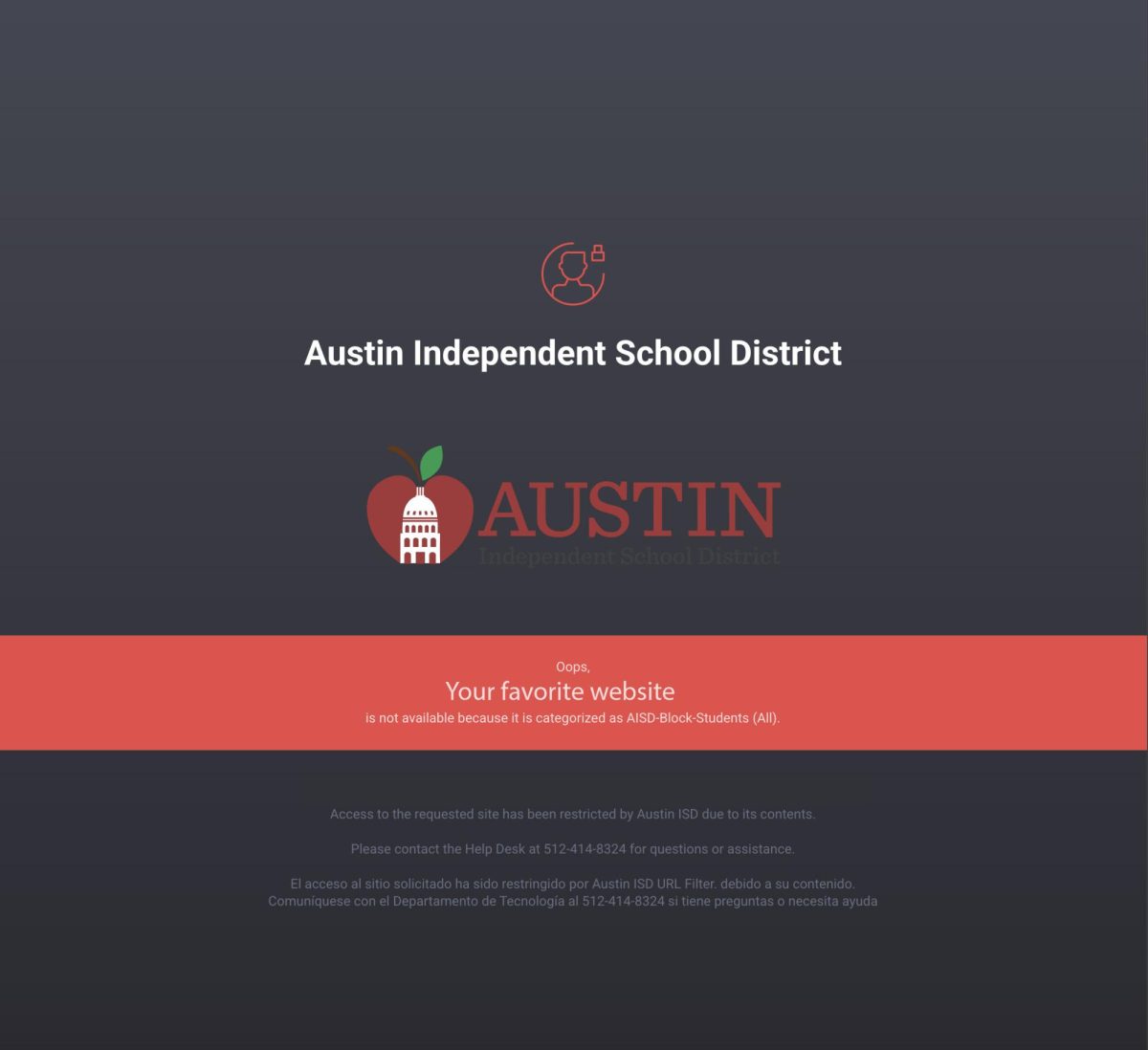
The Austin Independent School District’s policy to block websites from the Wi-Fi is too strict, and the administrators need to reconsider what they block. This firewall may be helpful in some ways in blocking mature content, but it is too strict.
AISD justifies this firewall with the claim that “students with smartphones can use cellular networks to access all internet content and apps”, yet now that Texas House Bill 1481 has been implemented, preventing students from using smartphones or any cellular device, students suffer the loss of digital resources.
Our district is disadvantaged with this block of resources. Students are blocked from using resources such as educational images, and are blocked from many photos every time they input a Google search. This prevents students from using most photos, even appropriate ones, making it difficult for students to use images for school projects or research.
AISD should consider changing this firewall at specific times and not have it on 24/7. The only way to change this is for a teacher to unblock specific websites for a student during their class, going into a teacher’s class before school, lunch time, or after school. I doubt most teachers know how to do this, or will do it.
Many students can’t do homework until they get home from many of their classes, because they are blocked from most YouTube videos, including ones required to watch for class. Students complain about their workarounds of resources they needed to be unblocked.
One website blocked on Chromebooks that frustrated the bulk of the student population is Pinterest. This website is used to discover ideas and inspiration, particularly for graphic design. My newspaper class needed to use Pinterest for a board on page design ideas for issues, and a club I’m in that organizes food drives used Pinterest to find ideas for a crafty box idea for dropping off books and food for the drives. Pinterest sparks many ideas for students, and it boosts our creativity.
This app/website is blocked on our Wi-Fi, and made finding these ideas more difficult, because we could only look at these boards when school was out. The only option to use it during school hours would be on a cellular device, and our phones are no longer legal to use during school hours.
Listening to music has also been a struggle during school hours. Spotify is blocked, so users cannot listen to music or look at their own custom-made playlists. Some students listen to music on YouTube, but they have to make a playlist. I would rather listen to the sounds of the classroom rather than music videos, and the music playlists I create take a while to create.
We can’t try watching any short reels on YouTube either. Some teachers will play reels for the students to watch for educational purposes. For example, when I was in world history class last year, we would watch Heimler’s History videos, a YouTuber who creates short videos for students in AP classes, as an integral part of our curriculum. Now, we can only watch these videos under cellular data or a different Wi-Fi.
On the contrary, some of the websites that are blocked help me stay more focused in class. All social media is blocked, such as Instagram, Snapchat and TikTok. Although many students argue against this, I believe that blocking social media is reasonable during school hours. I find that instead of watching short videos when I finish an assignment in class, I will do assignments for my other classes and study, which helps me get ahead.
There are so many random websites blocked as well, which are frustrating. Currently, I am blocked from a random primary source from the Salem Witch Trials, which I need to read for my U.S. history class. I am behind because I can only work on this at home because of this website being blocked, and I’m sure many other students experience this problem.
Any site offering an AI program is immediately removed for us to use as well. AI can be a very educational resource to help guide students with learning, yet administrators see it as only a way for students to exploit the resource, which can often be the case. Using AI to break down a problem for me, or summarize old English, can be extremely helpful, but it isn’t available for me to use until I leave school grounds.
Students are blocked from all of these resources as well, but teachers have full access to all websites while on campus. This makes things difficult for teachers because they aren’t aware of what is blocked for us.
Chromebooks must be used in the classroom, and we don’t have other options for technology we can use. Not only are phones banned, but computers cannot be brought besides our school-issued laptops.
Many websites should be accessible on our school grounds, and our blocked websites constantly vary. With a smaller amount of student resources, that could potentially affect grades. Many students in the district are considered “economically disadvantaged,” such as 20.7%, which is 384 students at our school. Many students do not have Internet access at home and depend on the school Internet to get their schoolwork done.
In total, AISD should consider changing this firewall, whether it’s a downplay of the massive amounts of specific websites blocked, or time limitations throughout only the school day. Whatever decision they choose, our district must change this policy.