


It’s a love for the craft that drives them to do it. Hours in the classroom sharing their knowledge and guiding students are spent alongside hours in the studio harnessing their own creative tendencies. As both teachers and artists, William Cauthern, Carey West and Abby Burnham lead intertwined careers united by one drive – passion.
For Design and Printmaking teacher William Cauthern, Room Art 2 is not just his classroom, but his studio as well. His high school experience, characterized by artistic friends and time spent in the art classroom, he was submerged in the visual arts realm and began to gravitate towards the field himself.
Thirty years ago, Cauthern began selling his art to his family, friends, and neighbors. Around the same time, he started working as a teacher.
“When I was younger, I volunteered and worked with young people and I’d always thought [teaching] was fun and a good way to channel my art and continue to do the creative process,” Cauthern said.
Cauthern is fond of his art’s ability to express himself visually rather than verbally. He describes his printmaking as straightforward, including symbols indicative of Austin from music to the changing skyline to biking.
“[I try] to find those simple things in daily life that reflect either my past or my current or how I experience the world,” Cauthern said. “Those are the common themes in my work because they’re the common themes I integrate into my community and into my world.”
However, teaching is time-consuming, and he often struggles to find the availability to pour into his own art.
“[Teaching] puts a big damper on my personal art experience because a lot of what I do is giving away my creative energy,” Cauthern said. “It’s a delicate balance.”
When the class of 2026 graduates this year, Cauthern will be retiring, and he is looking forward to having more freedom to delve into his own creations and explore more art forms. Currently considering himself a full-time teacher, Cauthern says the future marks his transition into being a full-time artist. Whichever lens through which his career is viewed, it is characterized by creativity.
“I like the energy of both,” Cauthern said. “I like the idea of creation from nothing. I feel like when we create, we are able to express ourselves. Especially in today’s society, that’s a great thing to do, [to] have a voice.”
Also seeing her life some day transitioning into being a full-time artist is Ceramics, Sculpture and AP 3-D Design teacher Carey West. But growing up, West never thought she was an artist. Living in what she describes as a hands-on, DIY family, she was always surrounded by an atmosphere of creation. But according to West, it’s a fine line between craftsman and artist, a distinction which she believes comes down to intention.
“I don’t really mind being called either one – artist or craftsman,” West said. “It took a very long time to think of myself as an artist.”
It wasn’t until the end of college that she began to view herself in this light. As a marine biology major, she never considered art as a career path, but rather as something she was interested in learning more about. Then one day, she discovered clay. She was hooked and she needed more.
“I’m just endlessly curious about what you can do with clay,” West said. “There’s a certain frustration when things aren’t going your way and there are endless mistakes in clay, but I love resilience, and I love a challenge. I love when it all goes wrong and you have to figure it out and make it work.”
She didn’t plan on being a teacher, either. But what began on a whim has steadily grown into a lasting career, standing 25 years later.
“At some point, I was like ’I’ll be a teacher and see how it goes,’” West said. “So, I don’t even know what it was. I just decided one day that that was the way to bring my science and art together.”
West finds joy in watching her students find joy.
“I really like it when students make something they’re proud of, when there’s that moment of didn’t-think-you-could-and-did,” she said. “If you put the time and effort in and you did it and you love it, then I’m a happy teacher.”
For West, teaching adds fuel to the fire of her personal art. What she experiences in the classroom, she takes to the studio, and what she experiences in the studio, she adds to the lesson plan.
“Teaching is inspiring as an artist, and it has given me the freedom to explore more avenues,” West said. “I think I learned more techniques because I wanted to teach them, and feeling the energy of an excited student is inspiring.”
West creates in her garage with a kiln on her back porch. Throughout the year, she will participate in various art shows where she sells her work, such as Austin Studio Tours and Greater Austin Clay Artists.
“I do it to be part of the community and in the hopes that I’m learning valuable knowledge, so that when I retire, I can put more effort into that part of my life and be a little more sustainable,” West said.
But it goes beyond practicality. For West, creating is a necessity. She is inspired by her own potential and what she has not yet discovered.
“Part of being an artist is because you have to be,” West said. “There’s a need to make or create that I have. I have an endless curiosity about the material and the surface and I’m just not happy if my hands are not making.”
She says she differs from other artists in the sense that she cannot be put into a box. According to West, ceramicists will often stick to a path in their work in order to be recognizable. But West’s paths lead to new paths.
“I struggle with wanting to do everything,” West said. “I’ve done enough experimentation and exploration that I have a pretty good breadth and depth of knowledge in ceramics, but if I had to say I am this one thing as an artist, I don’t know. I’m everywhere. I like to play and I like to try new things and I like to test the boundaries of what my skills can do.”
Also a ceramicist is teacher Abby Burnham. When Burnham was a senior in high school, she had the opportunity to take an art elective for the first time. With encouragement from her teacher and the value of education from her parents, she was pushed into teaching.
“I had a very inspiring art teacher [that] I saw how much enjoyment she had with her job,” Burnham said. “Eventually, she literally started mentioning to me that she thought I would be a great art teacher and that was something that ended up sticking with me.”
A teacher for 20 years, Burnham appreciates the connections the job entails.
“The absolute best is when I get to have a student in my class for several years so that I can really see how they grow and learn as both an artist and a human during that time,” she said.
Burnham is well-versed in the art business world, an artist and entrepreneur from an early age with experience dating to participating in craft fairs as a child. However, she was forced to put a halt on her art when she started teaching.
“It is a hard career and I care deeply about what I bring to the classroom, so I focused all of my energy on honing my teaching skills and it left little time for my own art,” Burnham said. “One of the things I’ve worked hard on during my career was to find better balance so that I keep space in my life for creating. Without my own art practice, I feel like I’m missing something.”
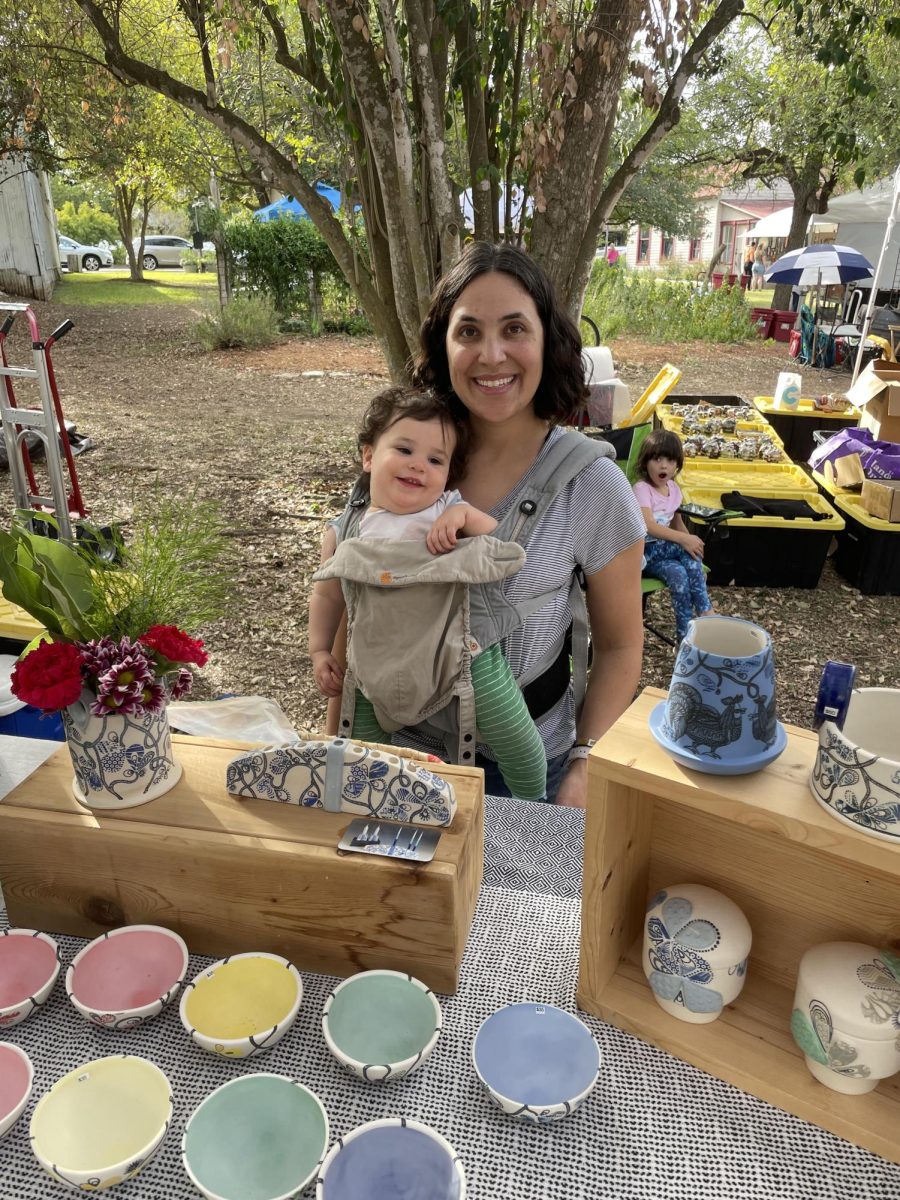
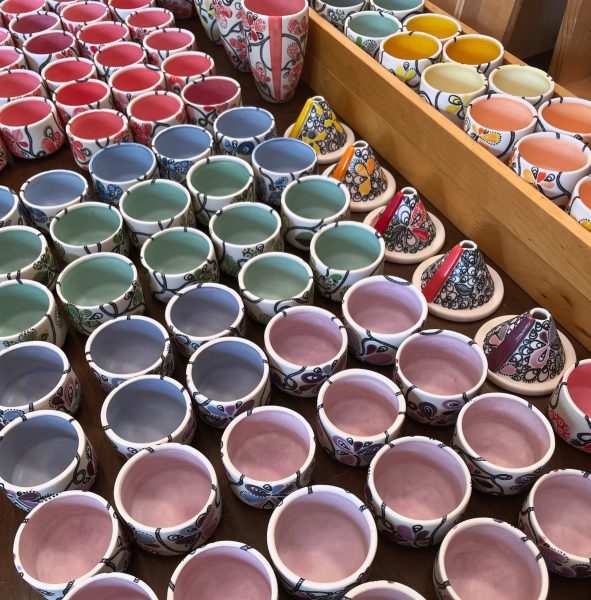
Burnham has found this balance in teaching part-time, which leaves room for her personal art and three children, ages 11, eight and four. She sells her art, consisting mostly of functional hand-built and slip cast ceramic pieces in the East Austin Studio Tours, Blue Genie Art Bazaar, Texas Clay Festival and Greater Austin Clay Artists. For Burnham, selling her art is a rewarding experience that she shares not just with herself, but with her customers as well.
“I definitely need a creative outlet as part of my personal mental health, and this gives me an area to channel my focus,” Burnham said. “But it’s also very affirming to see your art out in the world and to hear stories about how it’s used or where it has gone to [and] I want my artwork to bring some joy and whimsy into the world. I enjoy the idea that you can be holding a piece of art in your hand, that you can touch it, feel the texture, and still use it to drink or eat some ice cream out of.”
While art is of utmost importance to Burnham, she believes that it holds significance to us all.
“I love creating and seeing others create,” she said. “It’s a fundamental part of our humanity and is an important practice to culture, not something that should be viewed as an extra. The arts, of all varieties, are a record of history and fundamental to all of our lives.”