



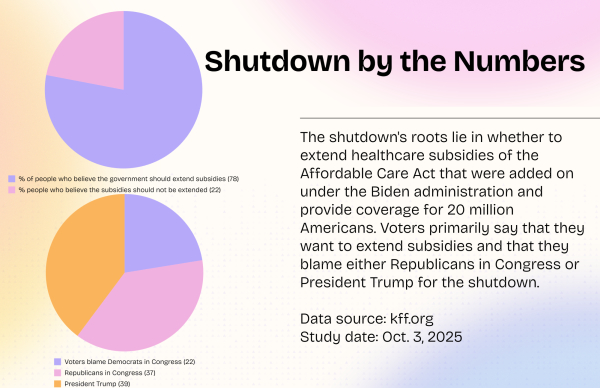
The federal government shutdown began on Oct. 1 as a result of budget disagreements between Congressional Democrats and Republicans. The disagreements primarily center on healthcare appropriations, with Democrats arguing for an extension of subsidies that provide healthcare to 20 million Americans and Republicans arguing against them. Their criticisms primarily hinge on their perception that the subsidies help insurance companies more than Americans. However, Republicans have proposed no alternative legislation to combat this. They’ve also accused Democrats of providing healthcare benefits to undocumented immigrants, a claim that is false; providing healthcare to undocumented immigrants goes against federal law. However, Democrats actively seek coverage for asylum seekers and recipients of the DREAM Act. On Nov. 10, the Senate reached a 60-40 compromise to end what was the longest government shutdown in history, sending the funding bill to the House for approval.
The shutdown also affects a significant portion of the 3 million members of the federal bureaucracy. As of Oct. 6, 620,000 government workers have been furloughed, including at least half of civilian workers for the Department of Defense. Agencies that continue to function with slashed workforces include NASA, the National Weather Service, and the Army Corps of Engineers. Congress continues to be paid throughout the shutdown.
For senior Kaylen Foradori, the shutdown is personal. Her father, David Foradori, works for the Transportation Security Administration, one of the agencies most heavily affected by the shutdown.
“All of the TSA workers are just expected to show up and do their jobs,” Foradori said. “Everything in TSA has been affected — flights are getting slower, people are getting mad. Empathy right now needs to be with the government workers. They have families and children to feed.”
For Foradori’s family, the shutdown is a considerable source of anxiety during an incredibly stressful period of their lives.
“My dad’s been having a lot of issues with his sinuses and a lot of issues breathing,” Foradori said. “He recently had surgery to fix all of that.”
Foradori’s father has continued working, despite not receiving his salary due to the shutdown and sustained medical concerns.
“My dad leaves at 10 a.m. in the morning and leaves work at 7:30 p.m,” Foradori said. “He’s really tired every single day. On top of all that, my dad has been going through a number of health issues and we don’t have money for all of the medical bills either. This whole shutdown is just exacerbating every issue.”
The shutdown also set into motion Foradori’s decision to attend Austin Community College, as she wants to make the most financially responsible decision for her family and avoid debt.
“This [shutdown] did influence my decision to go to ACC because now we actually really don’t have money,” Foradori said. “I’m making a lot of decisions to save money. I’m being forced to grow up. I’m 16 and I should not have to be worrying about how much food is going to be and if I can afford college.”
According to Foradori, the shutdown compounds already dire inflation for American families, including her own, and represents a failure of partisan groups in Congress to compromise for the interests of their constituents.
“I’ve always been on the left, but it does make me think more about the politics around me and how it affects the community,” Foradori said. “It made me realize that this is real life. The things on the news are real. It’s jarring to live through. It’s so normalized, it makes you feel like you’re going crazy. On top of everyday stress, it’s just obscene.”
Government teacher Erin Summerville agrees that the shutdown is hindering the government’s ability to effectively serve Americans.
“Any shutdown demonstrates serious dysfunction at our nation’s capital,” Summerville said. “It is a cause for concern that the shutdown has been going on for so long.”
Summerville explained that the root cause of the shutdown was the need for Republicans to attain cloture, the 60 votes necessary from Senate members to end the Democratic filibuster on the healthcare subsidies. A filibuster is a speech delivered by the minority party in Congress to delay or prevent the passage of laws.
“In a nutshell, Senate Democrats were able to block this because Republicans needed them to get their sixty votes,” Summerville said. “Despite the Republicans having unified government, the minority party in the Senate often benefits from the 60 vote requirement.”
Fellow government teacher Cat O’Neal witnessed the effects of the shutdown on national parks earlier this month when visiting Big Bend National Park with her family.
“We went to Big Bend, and there were no park employees there,” O’Neal said. “People were there, it was running as normal, but you didn’t have to pay to get in. The Visitors’ Center wasn’t open. But pretty much everything was functioning as normal.”
O’Neal teaches Foradori in her government class and believes that both teachers and students have a role to play in helping students meet the demands of school and their home lives.
“The most important thing for teachers is being compassionate to students regardless of what you do or don’t know,” O’Neal said. “The most important thing for students is self-advocacy, like asking for extensions or giving context to their situation. Teachers can’t always know what’s going on with over 100 students.”
O’Neal also said it can be difficult for teachers to assess student needs, in both crises like the shutdown and in everyday interactions.
“As a teacher, you don’t know what students are dealing with at home,” O’Neal said. “You never know their financial situation, their caregiver situation. The dynamics of hardship on students are so infinite.”