

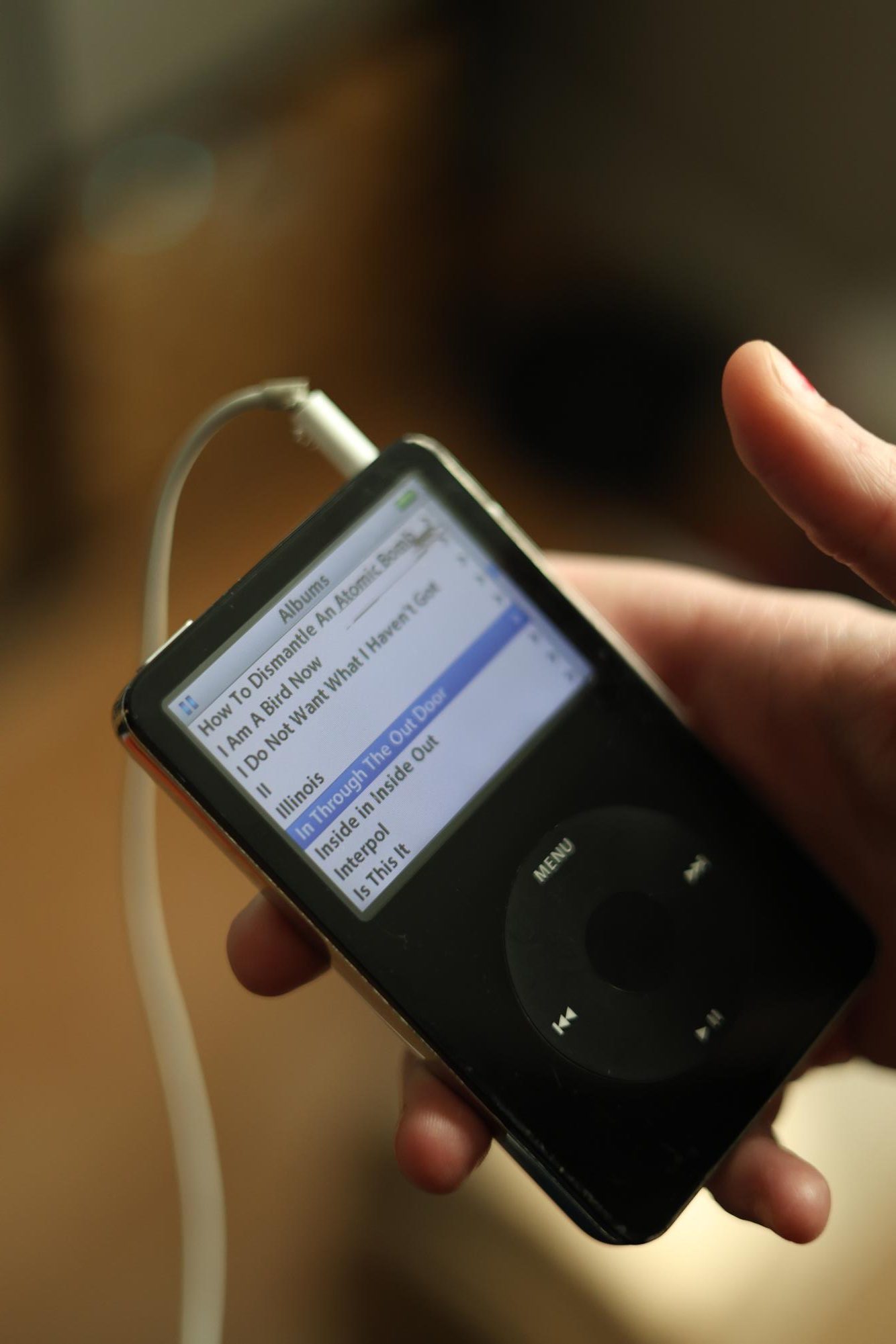
Every passing period, students walk swiftly to class, shoulder to shoulder with one another, with noises hovering around them. In previous years, students could easily connect their headphones to their phones and listen to whatever songs of their choosing to break the cloud of sound. However, with the passing of House bill 1481, all phones and headphones are prohibited. Nevertheless, wired headphones were still allowed. Even without access to a phone, students still have ways to listen to music — even if they have to turn back time a little bit.
Back in 1979, Sony released the very first Walkman. At the start, it was used by inserting a cassette tape and connecting a pair of headphones. The Walkman was portable and could be carried anywhere, a stark contrast to other analog media at the time, which were relatively stationary. With the introduction of CDs, Walkmans modernized. They morphed into Discmans, and shortly after Apple’s iPods began getting traction, they turned everything digital. However, production of Walkmans ended in 2011.
Even with Walkmans ceasing to be sold in the U.S., modernized versions are still available at various stores, including Amazon. With the introduction of HB 1481, attraction towards Walkmans and iPods boomed. Although many students simply used their parents’ old ones, students who may not have that luxury will soon have a new space where they can have access to them within their own school.
McCallum librarian Matthew Zuniga has been collecting analog media since he was young, and as soon as he noticed its rise in popularity throughout McCallum, he had a plan.
“I’m hoping to be able to provide an area where students can check out CDs or cassette tapes, so that if they want to listen to those, they can,” Zuniga said. “Obviously, with this cell phone ban, they’re not able to listen to music on their phones or use Bluetooth. They can use their Chromebooks, but I’ve seen students, so I’ve been asking for donations from parents, and I’ve started to get some in.”
According to Zuniga, having these resources in students’ own libraries will allow them to experiment with music in a new way. Plus, it creates a community, as they connect with others who share a similar interest.
“I do think that it can help to establish a community if two students are checking out CDs together,” he said. “It helps provide a place for students to go, especially if they’re in a certain scene sharing CDs, there’s something about sharing music and thinking ‘hey this is what I like and you might like it too,’ it’s vulnerable and helps people to connect.”
Similarly, Zuniga also acknowledges how this will be an introduction to analog media for a lot of people; however, he hopes it could also be the start of a new passion for a lot of eager students.
“I think using Walkmans and iPods is super cool, and something even I grew up doing,” he said. “Having something tangible you can share with other people or easily carry around and have all your music in one place is just so much cooler and helps you connect with the music or whatever you’re engaging with more than just throwing something on from a Spotify playlist.”
Despite Walkmans being obtainable from online shopping platforms, Zuniga believes that being able to support your local libraries and record stores helps to promote a city that thrives off of music.
“Libraries have always been much more than just books,” he said. “Even if books are a huge part of it, it’s always important to notice what students are interested in and what they’re doing, so you can continue to evolve alongside the students.”
Along with libraries serving as an ever-important resource, students have had a booming interest in Walkmans on their own accord as well. For junior Jude Singh, it allowed him to still listen to his favorite music in busy hallways.
“I think the hardest thing with the phone ban for me was being able to listen to music in the hallways, so I wanted to continue doing that this year,” Singh said. “I got a cheap $20 Walkman off of Amazon, and even though it was a huge struggle getting all the songs on there, it still worked.”
Even though dated technology may double as a time machine, it still has several issues.
“The issue was that I imported my liked songs, which included songs from several months ago,” Singh said, “So if I wanted to update it, I would have to update it completely and reinstall all my recent liked songs, which can become an inconvenience. I can listen to some completely random record straight from my phone, and I can’t do that with an MP3 player. You have to know enough about the music to want to go through the effort of transferring it.”
Regardless, Singh believes that analog media, such as MP3 players and iPods, are still important and can change the way that a listener perceives the music.
“People are always going to find alternative ways to listen to music,” Singh said. “It’s a lot cooler when you’re able to physically hold the music you listen to, even if you tend to get a wider variety of music when streaming.”
In parallel to Singh, sophomore Isaac Elbel had fond memories using iPods and was excited to pick them back up after being motivated by the phone ban.
“The second I heard about the phone ban, I was already trying to find some way to still have music in my ears, and I found that in my iPod,” Elbel said. “I remember very vividly having an iPod when I was younger, and loving it. It took a little while for me to find a new, more affordable model, but it was worth every penny.”
Music has always had a community around it, and in tandem with Zuniga, Elbel believes that students with similar music tastes can connect.
“It’s so much fun to see all the albums you’ve collected, and other people can scroll through and see what music you have in common,” he said. “It feels more rewarding, and it makes me feel more productive.”
Even with an increase in age, Elbel believes that the quality of the music, along with the sound technology, is still up to nearly up to par with modern speakers and headphones.
“Despite being slightly lower, it depends on a lot of factors,” he said. “For example, what headphones you’re using, your model of iPod, the site you used to download the music, but it’s nothing to rub your nose in, it still sounds great.”
With the passing of HB 1481, lots of daily routines got thrown up into the air, as students scrambled to pick them back up in a compliant way. Thanks to MP3 players, iPods, and Walkmans, along with resources such as McCallum’s own library, students can still fill silences in a fulfilling way.