

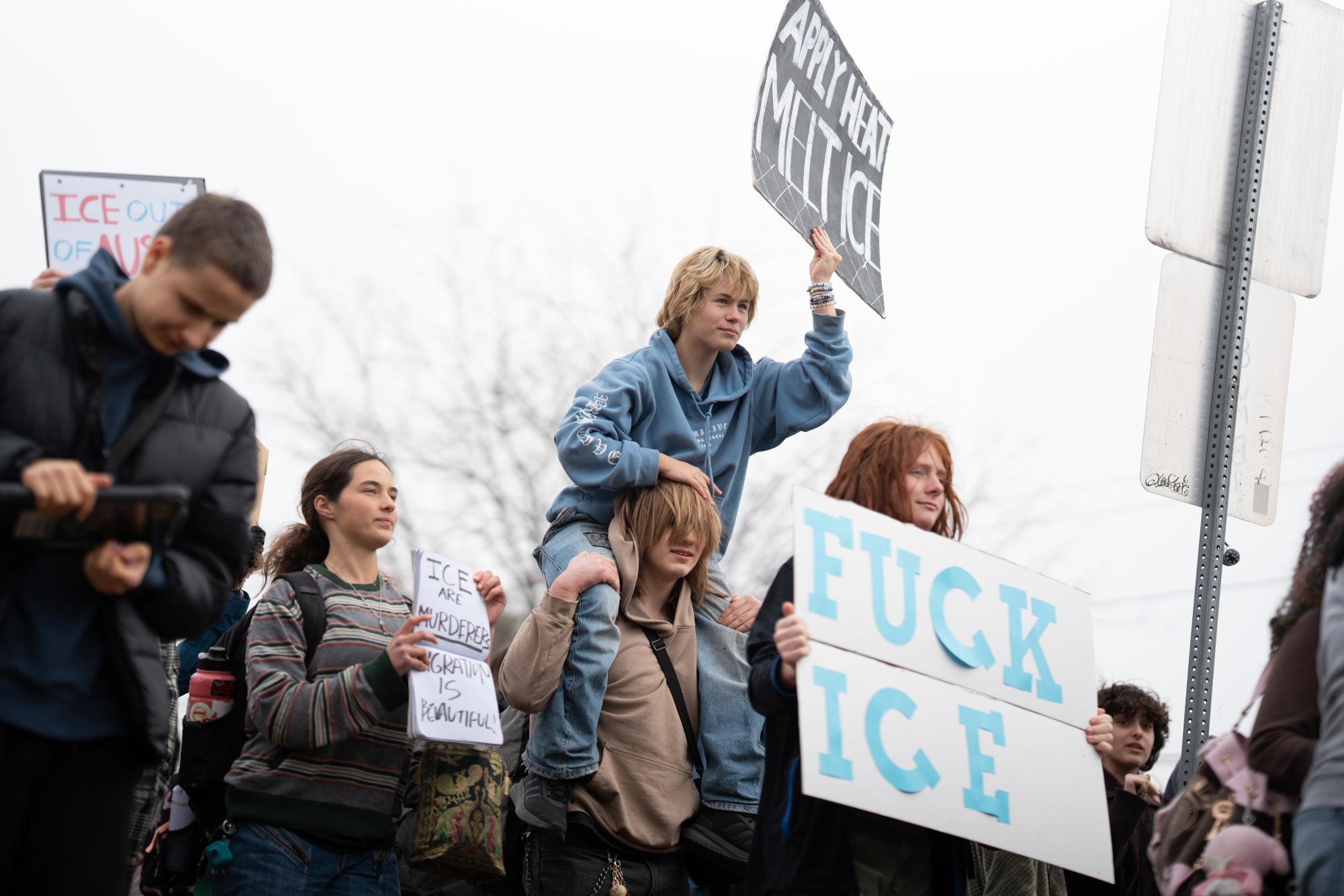
In early 2026, the administration underneath Donald Trump’s advisement started their immigration crackdown through the introduction of high amounts of ICE, United States Immigration and Customs Enforcement, agents in highly populated areas. In his first term, Trump signed into effect the executive order, Enhancing Public Safety in the Interior of the United States, which granted permission for ICE agents to deport and send all unauthorized immigrants to detention centers.
ICE was created in 2003 as a result of the Homeland Security Act of 2002, but only to specifically remove unauthorized immigrants who committed crimes. This was a response to the 9/11 attacks performed and carried out by Al-Qaeda. However, it wasn’t until Jan 6, 2026 when ICE started their first complete crackdown in Minneapolis, Minnesota where 2,000 federal agents were deployed dressed in civilian clothing with face coverings to keep their identities hidden.
Due to the increased presence of social media and video coverage, many people across the country have been able to see the extent to which ICE agents go to find and arrest unauthorized immigrants. Video footage also allowed for Renee Good’s and Alex Pretti’s deaths at the hands of ICE to be spread nationally which sparked outrage.
Due to their fury with the presence of ICE agents, The Somali student group in Minneapolis organized a strike and called on the other students across the country to do the same. Senior Reese Armstrong heard this call and got together with his fellow chairman of McCallum Young Democratic Socialists of America sophomore Riana Florek to organize a school walkout. Armstrong also got into contact with Issac Braman-Ray, a senior at LASA, who leads the LASA YDSC to share his idea of the protest.
“ICE is terrorizing our communities and we need[ed] to stand up and do something,” Armstrong said. “I’m feeling both distraught at seeing the expansion of secret police laying siege on American cities, turning their fascist aggression inward, but also incredibly hopeful for the future of our movement.”
The McCallum protest took place on Friday Jan. 30 during lunch and third period where over 500 participated. McCallum students gathered in front of the school around 1:30 p.m. and marched around the campus for three miles holding signs declaring their hatred and want for ICE to be abolished. While the protest was thought of and led by the members of the MAC YDSA, many members of the community came out, including a voter registration volunteer who helped to register students who were 18.
“On a political level, young people are one of the strongest blocs for left-wing politics and civil rights movements throughout history, from Vietnam to South Africa to Palestine, and we can be a powerful force for making change,” Armstrong said. “On a basic level, because everyone deserves to have their voice heard but in order for that to happen we have to organize.”
There were also other walkouts to protest ICE and their crackdowns performed by LASA, Crockett High School and 11 other AISD schools on the same day.
At all schools, AISD School Resource Officers accompanied the protests to ensure the safety of those protesting. Due to the presence of AISD SROs, Texas Attorney General Ken Paxton is demanding documents as part of the investigation into Austin ISD. These officers are being investigated due to the belief that they helped and allowed students to skip school.
Reflecting on the protest, Armstrong is pleased with the turnout but also acknowledges that there is still more work to be done in terms of ICE occupying areas.
“[Protesting is] just the first step but shows that students are ready to fight,” he said. “We have been committing these heinous war crimes for decades now, and it’s time to shrink the American military empire to save lives and build liberation for people across the world. I hope [they’ve] been disowned by your family and live the rest of [their] lives in shame for what [they’ve] done, kidnapping and trafficking kids and the poor.”
Another reason that Armstrong, Florek and Braman-Ray organized the walkout was to respond directly to the ever-increasing presence of ICE agents in Austin and the surrounding areas.
“I’m scared for our communities, knowing that cops are hunting down our neighbors,” Armstrong said. “We must take action to get them out of Austin.”
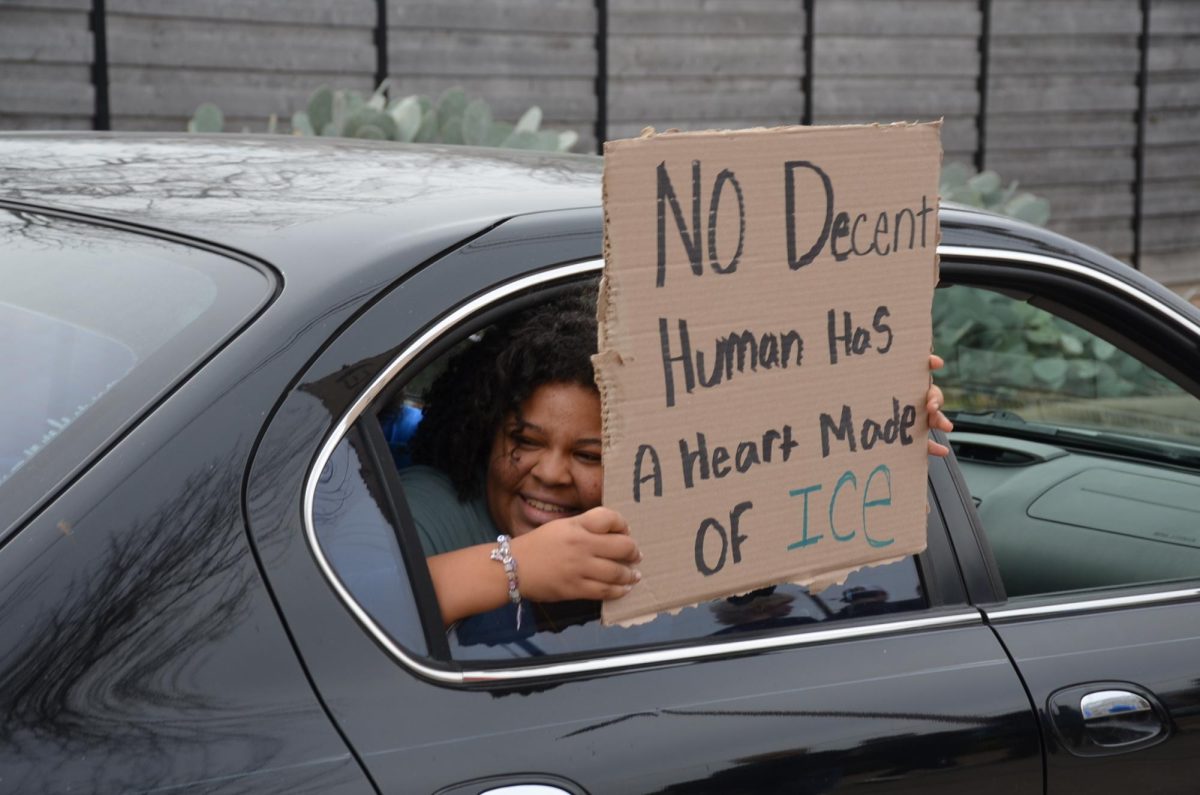
James Hutch, the English as a Second Language teacher, has directly seen the impact that the presence of ICE agents has on his students. Even before ICE occupied Austin, he noticed how even the thought of ICE affected his students, even if they didn’t talk about it.
“I have observed a developing vibe in some of my classes over the past couple years,” Hutch said. “I see how they’re different now than they were a couple years ago, and it makes me feel yucky.”
As a teacher, he doesn’t allow the feelings to affect the way that he teaches the direct curriculum, but he acknowledges that being a teacher is not just delivering the curriculum, but is also connecting with the students.
“If you’re doing the job correctly, you’re addressing the whole child or the whole student,” Hutch said. “If a kid is stressed out at home, or the parents are afraid to go to work so maybe they don’t have food, that’s going to affect learning.”
Something that makes teaching students how to learn a new language and get them acquainted with the United States culture hard, is that it’s not content based. Learning a language is skill-based and the classwork has to vary depending on the level of the student more so than in other classes.
“You just practice a lot, do it a lot, and you get better at it,” he said. “You have to communicate and I think that when your emotions are all jacked up because of whatever’s going on in your life, it affects language acquisition a little bit more than other subjects.”
According to Hutch, he is pretty good at compartmentalizing his feelings, but seeing how his kids are feeling when it comes to leaving their house and the fear that he feels for them, it’s hard to completely ignore his feelings at school.
“Well, if [leaving the house] is an issue of [their] safety, stay safe,” Hutch said. “But then at the same time, I also want to be punk rock and say [they] deserve an education and [they shouldn’t let] anybody scare [them] out of getting that. That’s a line [they] have to walk but I don’t think [they] should have to walk that line as a kid.”
For an anonymous kid from El Salvador, who will be referred to as Juan in this article, choosing his safety over getting an education was the decision he ultimately had to make. At the end of the last semester, Juan had to get his legal status renewed at an immigration court. However, his family did not feel comfortable taking him due to the presence of ICE, so his legal status expired.
Juan decided to stop coming to McCallum once the semester finished because he realized that all it would take is being stuck in traffic one day on the way to school and ICE being there for him to potentially get deported or separated from his family.
“In any moment, all it would take is some bad luck for ICE to grab me, and that’s it,” Juan said. “With my family, we made the decision that this was going to be the safest route for us, given everything that’s happening.”
Although Juan isn’t attending school anymore, he has entered the workforce like the rest of his family. While there is still a chance for ICE to locate and investigate Juan, he does feel safer at his workplace than he ever did at school. Even with the little bit of safety, Juan and his family have decided not to leave home at all, except when it’s necessary like for food or for work.
Despite the fact that the future is uncertain for Juan and his family in terms of returning to El Salvador to escape the risk of ICE, or staying in the United States to continue working, Juan wishes that ICE agents would realize the impact that they are having on families who are trying to seek out a better future for their children.
“I would ask them to think of the families that they’re destroying,” he said. “If they would like for someone to be doing this campaign against them. That they think about everyone who is affected; parents, families, orphans. All the people we know about and all the people we don’t.”