

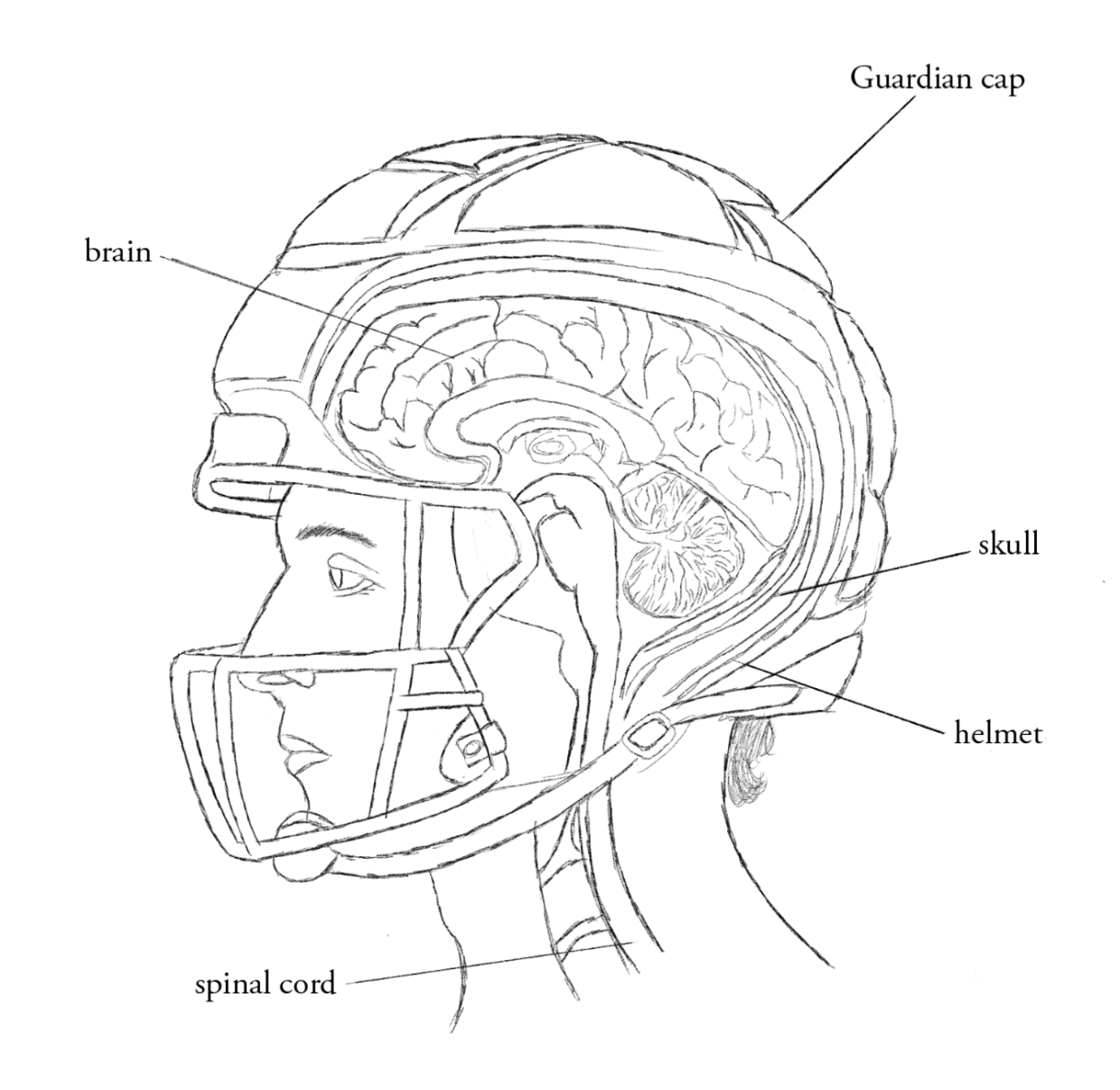
In the winter of 2024, head football coach Thomas Gammerdinger pulled a couple of players from their workouts and had a meeting with them in his office. In this meeting, Gammerdinger introduced the Guardian cap: a soft, padded shell that fits over the top of a standard helmet and is designed to absorb impact and reduce concussions. After a season marked by multiple injuries, the most prominent of all being concussions that sidelined some key players, Gammerdinger was looking for ways to keep his team safer. He explained that the NFL had mandated these caps in practice, and some players even started wearing them in games. But Gammerdinger’s plan went further: he wanted players wearing them at all times, both in practice and on Friday nights alike. Knowing the change might look unusual, he asked for his players’ opinions before making it official. Every player he asked voted for safety, and by the start of the 2025 season, McCallum became one of the few high school programs to fully adopt the Guardian cap. McCallum wasn’t the only program to make the switch to safety; teams at all levels started to experiment with the Guardian cap. But as all of these programs adopted the Guardian caps, one question stuck around: do these Guardian caps really make the game safer? As a player who was in that room, and has played in these Guardian caps, I believe that these padded shells make a substantial difference in contact reduction, concussion rates and player confidence.
Guardian caps gained national recognition in 2022, when the NFL introduced a new rule that mandated all linemen, tight ends and linebackers to wear the Guardian caps in preseason practices. The goal was to try and reduce the risk of head injuries in practice, especially with the positions that tend to experience more frequent high-impact collisions. Several college programs quickly followed the NFL’s lead; the University of Georgia, Vanderbilt University and the University of North Carolina mandated these shells in practices. In the 2024 season, the National Collegiate Athletic Association allowed them to be worn in games, and in 2025, Missouri defensive lineman Darris Smith became the first Southeastern Conference player to wear the Guardian cap while playing. While teams at the highest level adopted these helmet covers, researchers and league officials started tracking their impact. The NFL and several collegiate programs have done studies on how effective these caps are at protecting players.
In the mandated period of preseason practices, NFL Player Health & Safety reported that the position groups required to wear Guardian caps saw a more than 50% reduction in concussions in that preseason compared to the 2018-19 and 2021 averages. Furthermore, an independent study by Funk et al. (2025) confirmed this; they found a 54-62% reduction in practice concussion rates for the affected position groups after the Guardian cap requirements. Going down a level, a study by the Virginia Tech Helmet Lab conducted a series of controlled lab tests to measure how Guardian caps affected helmet impact forces. Their study found that the Guardian cap reduced the peak forces experienced by the head during collisions by 15-34% depending on the location and severity of the hit. While these results show that the guardian caps can lower the risk of head injury, it cautions that these results will not perfectly reflect how they will perform in-game. This isn’t just at the pro and college levels either. According to data from McCallum’s training staff, in the 2024 season alone, McCallum had nine concussions in 10 games across all levels of football. With the introduction of Guardian caps this year, McCallum had only five. It’s a safe estimate based on the evidence that the number of concussions in the program has gone down 44.4%.
While the Guardian cap has clearly made a difference, it isn’t the only factor influencing concussion rates. Coaches and trainers often emphasize that proper tackling form, improved neck strength, and safer practice habits also play huge roles in preventing head injuries. The Guardian cap can reduce the impact of collisions, but if players lead with their heads or ignore safe techniques, the risk of concussion still exists. Many experts argue that true player safety comes from combining equipment innovation with strong fundamentals and education. McCallum’s coaches have long emphasized proper tackling form and neck strengthening, running “neck drills” and “form tackling” drills almost daily to build muscles and tackling form that help reduce concussion risk. In that sense, the Guardian cap works best as part of a larger culture of safety, one that emphasizes smarter play just as much as smarter gear.
When the McCallum football team wore them for the first time, they felt awkward. Truth be told, when I first started using the Guardian cap, I didn’t like it at all. I felt like something was slightly off, I thought it made me look stupid and I thought it made me seem like a wimp. But as I started using them in practice, my opinion completely changed. The Guardian cap reduced how many times I had to take a breath and stop playing after a big hit, it reduced how many times I was afraid to engage a guy bigger than me and it reduced my fears about getting a concussion or developing CTE later on in my life. I’m not the only one, either. My teammates expressed similar sentiments. One player went on to say that the transition to guardian caps led him to feel less of a stinging sensation after hits and overall has allowed him to be a better player.
Even though the Guardian cap may look a bit odd, its impact on player safety and confidence cannot be overstated. What started as an experiment in NFL practices has now evolved into a proven advancement that protects athletes at every level of the game. The data from the NFL, Virginia Tech and McCallum all point toward the same conclusion: fewer concussions mean safer players and a stronger game. By reducing the fear and likelihood of injury, these caps allow players to focus more on performance and less on the risks. As football continues to evolve, the Guardian cap represents more than just extra padding; it symbolizes progress, responsibility and the future of a safer sport.